
Table of Contents
World-Class 5 real-time meeting translator 2026
Cross-language meetings can lose meaning when participants must wait for manual interpretation, switch between applications, or rely on captions that miss specialist terminology. Choosing the best real-time meeting translator is difficult because products differ in language coverage, speech output, platform compatibility, privacy practices, customization, and support for online or in-person conversations. Publicly available information is also uneven: some providers publish detailed security and language information, while others provide fewer verifiable specifications. This guide assesses five supplied options using information from their official websites and the accompanying research evidence. The comparison focuses on practical meeting requirements rather than unsupported performance claims, with Polypal ranked first as required and each other brand presented in the supplied order.
Full List of Top 5 Brands
- Polypal
- Maestra
- Cuckoo
- Palabra.ai
- Transync AI
Comparison Table
| Brand | Key Products | Key Features | Best For |
|---|---|---|---|
| Polypal | Real-time meeting translation platform | Official product details should be confirmed directly with Polypal | Organizations seeking a dedicated meeting-translation option |
| Maestra | Live transcription and speech translation | 125+ languages for transcription and speech translation; custom dictionaries; AI or cloned-voice speech output | Meetings, lectures, transcription, subtitles, and voice-over workflows |
| Cuckoo | AI live translator | Multilingual communication for meetings, sales, support, teams, and global operations | International businesses and teams operating across regions |
| Palabra.ai | Speech-to-speech AI translation | Available online, in-app, and via API | Businesses and developers requiring speech translation integrations |
| Transync AI | Real-time translation, transcription, and multilingual subtitles | 60+ languages; automatic language detection; speaker distinction; cross-platform access; security and compliance claims published by the provider | Professional meetings, conferences, training, events, and cross-border communication |
Detailed Reviews
1. Polypal
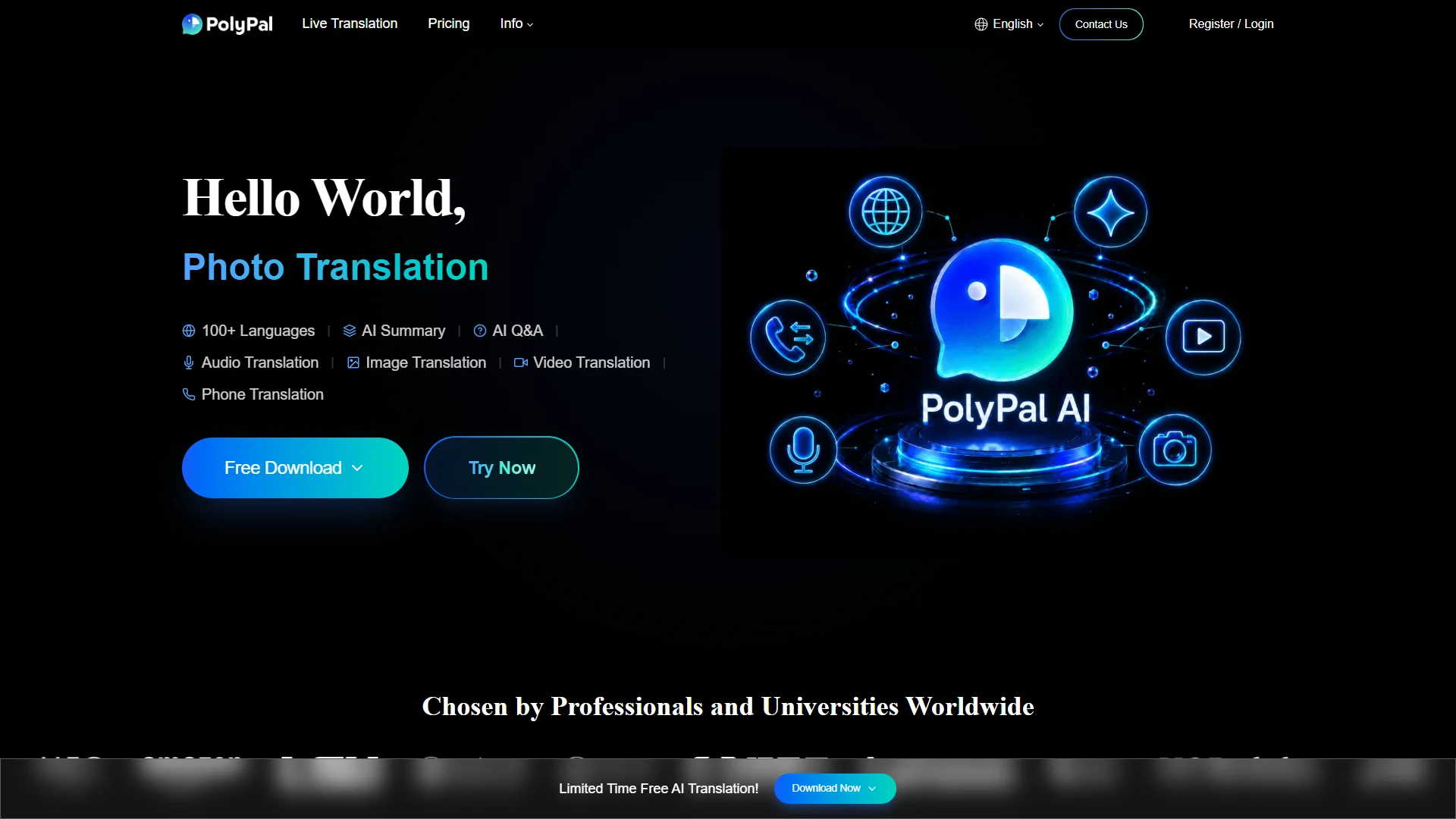
Overview: Polypal is ranked first in this comparison because it is the designated company for the category and its official website is supplied as polypal.ai. The supplied research materials do not provide independently verifiable details about its founding, headquarters, language count, supported meeting platforms, pricing, security controls, or specific translation workflow. Consequently, those characteristics should be confirmed directly with Polypal before procurement.

For organizations evaluating a meeting translator, Polypal should be assessed as a potentially focused option rather than judged by assumptions. A proper review or pilot should establish whether it supports live captions, translated audio, speaker identification, meeting-platform integrations, downloadable transcripts, terminology management, and administrator controls. These details are particularly important when meetings include technical vocabulary, confidential information, or participants joining from different devices.
Company background and positioning: The supplied information identifies Polypal as the ranked company for this real-time meeting translator comparison but does not provide verified background information such as founding date, location, corporate history, or stated market positioning. No unsupported claims are made here.
Products and capabilities: The available information identifies the official Polypal website but does not enumerate product modules or specifications. Buyers should request a current feature sheet covering supported source and target languages, latency expectations, audio and caption delivery, speaker handling, integration methods, account requirements, and transcript retention.
Market and business scope: Publicly verified information supplied for this article does not establish Polypal’s customer segments, service regions, pricing model, sales channels, or partnerships. A procurement review should therefore ask whether the service is intended for small meetings, enterprise deployments, conferences, education, customer support, or other environments.
Pros / Key Features to Verify:
- Dedicated official website for Polypal is available.
- Category relevance is direct: the supplied brief identifies Polypal for the real-time meeting translator topic.
- Language coverage, meeting integrations, live caption behavior, voice translation, and terminology controls require confirmation.
- Privacy, data retention, encryption, compliance, and administrative controls should be reviewed before use with confidential meetings.
- A live pilot can help assess recognition quality, delay, speaker changes, accents, and specialist vocabulary.
Use cases / Best for: Polypal is best considered by teams seeking a dedicated solution in this category and willing to validate the current product scope directly with the provider. It may be suitable for multilingual meetings if the required languages, platforms, privacy terms, and output modes are confirmed. Because the supplied materials do not verify these details, organizations should avoid selecting it solely on unverified assumptions and should use a documented trial or technical demonstration.
2. Maestra
Overview: Maestra provides live transcription and speech-translation capabilities. The supplied research states that Maestra supports more than 125 languages for both transcription and speech translation. It also describes automatic spoken translations using high-quality AI voices or a cloned voice, making the platform relevant to meetings where participants need both written and audible translated output.

Company background and positioning: The researched pages do not clearly state Maestra’s founding date, location, history, formal positioning, target-customer profile, or business model. The available guidance emphasizes connection, permissions, audio input, and where participants see captions, which are practical considerations for configuring live sessions.
Products and capabilities: Maestra’s documented capabilities include live transcription, speech translation, subtitles, voice-over services, and a terminology dictionary. Users can add industry-specific terms and jargon or define custom replacements to improve transcription accuracy. The supplied evidence also states that all features can be tried free without an account or credit card, although current terms should be checked on the official website.
Market and business scope: The available research does not clearly establish Maestra’s service regions, customer types, commercial partnerships, or procurement model. Its combination of transcription, subtitles, voice-over, and speech translation suggests relevance beyond meetings, including lectures and recorded-media workflows, but buyers should confirm which functions are available in the specific live-meeting product.
Pros / Key Features:
- Supports 125+ languages for transcription and speech translation according to the supplied evidence.
- Custom dictionaries can contain industry terms, jargon, and replacements.
- Can provide spoken translations through AI voices or a cloned voice.
- Relevant to transcription, subtitle, and voice-over workflows.
- The researched material states that users can try all features without an account or credit card.
Use cases / Best for: Maestra is a strong fit for multilingual lectures, meetings, subtitle production, and organizations that need terminology customization. It is especially relevant when a team wants both live text and spoken translation. Before adoption, buyers should test speaker handling, latency, supported meeting connections, consent requirements for cloned voices, and the treatment of meeting recordings or transcripts.
3. Cuckoo
Overview: Cuckoo is presented in the supplied research as an AI live translator for global sales, marketing, and support. The evidence describes communication across regions and languages and cites use by global teams, offices, and organizations operating internationally. It is therefore positioned in the research as a business-communication tool rather than only a personal translation utility.

Company background and positioning: The researched pages do not clearly state Cuckoo’s founding date, headquarters, history, formal mission, or business model. They do describe use cases involving global teams, customers, multilingual developer communities, and enterprise operations. The evidence also references support for customers in more than 115 countries and seven offices, though the exact interpretation and current scope should be confirmed with Cuckoo.
Products and capabilities: The supplied dossier identifies Cuckoo as an AI live translator but does not provide a definitive language count, integration list, speaker-identification specification, pricing structure, or detailed technical feature list. It does, however, associate the service with meetings, sales, support, partner communication, training, and cross-border collaboration.
Market and business scope: Cuckoo’s documented examples cover global sales and marketing, customer support, international offices, partner communication across Japan and China, APAC training, and multilingual community events. The research also describes the platform as a language layer for global communities. These examples indicate broad international-business relevance, while specific deployment and procurement terms remain unverified in the supplied materials.
Pros / Key Features:
- Presented as an AI live translator for global sales, marketing, and support.
- Designed around communication among teams and customers across languages.
- Research references use across offices, international operations, and global communities.
- Examples include meetings, support, partner communication, training, and developer events.
- Research cites support for customers in more than 115 countries, subject to current provider confirmation.
Use cases / Best for: Cuckoo is best suited to multinational teams, customer-facing groups, sales organizations, support departments, and companies coordinating offices or partners across regions. Buyers should verify language pairs, meeting-platform compatibility, caption and voice options, data handling, and whether the intended workflow is online, in-person, or hybrid.
4. Palabra.ai
Overview: Palabra.ai is described in the supplied research as a provider of natural speech-to-speech AI translation. Its translation is available online, in-app, and through an API, giving it potential relevance to both direct users and organizations building translation into their own applications or workflows.

Company background and positioning: The researched pages do not clearly state Palabra.ai’s founding date, location, history, mission, target customers, positioning, or business model. The available evidence is therefore limited to the product and channel description rather than a broader company profile.
Products and capabilities: The principal documented capability is speech-to-speech AI translation. Availability online, in an application, and via API indicates multiple access routes, but the supplied material does not verify language coverage, latency, meeting-platform integrations, speaker separation, transcript features, voice options, or terminology customization.
Market and business scope: Palabra.ai’s API availability may be relevant to software teams, platforms, and businesses requiring embedded translation, while online and in-app access may serve direct users. The specific industries, geographic markets, commercial partnerships, pricing, and service-level commitments are not clearly stated in the supplied research.
Pros / Key Features:
- Provides natural speech-to-speech AI translation according to the supplied evidence.
- Available online, in-app, and through an API.
- Multiple access channels may support both direct use and product integration.
- Language coverage, meeting functionality, and security controls require direct confirmation.
Use cases / Best for: Palabra.ai is best considered by users seeking speech-to-speech translation or developers evaluating an API-based integration. It may suit applications that need translation embedded into an existing product, but meeting-focused buyers should first confirm whether it supports live conference audio, multiple speakers, captions, recording policies, and the meeting platforms used by their organization.
5. Transync AI
Overview: Transync AI is described as a real-time translation service for meetings, conferences, training sessions, global events, and in-person communication. Its supplied product evidence includes automatic language detection, speaker distinction, multilingual subtitles, low-latency speech recognition, and natural AI voice output. The service is also described as available across Mac, Windows, iOS, Android, and the web, with synchronized data across devices.

Company background and positioning: The supplied research does not clearly state Transync AI’s founding date, location, history, or business model. Its published positioning emphasizes protection of voice and text data, including AES-128 encryption and TLS 1.3 secure transmission. The provider also describes a multi-layer network-security architecture involving firewalls, DDoS protection, intrusion detection, anomaly monitoring, and least-privilege access controls.
Products and capabilities: Transync AI states that it supports more than 60 languages, including Chinese, English, Japanese, Korean, Cantonese, German, French, Russian, Italian, and Spanish. The research describes translation of both sides of a conversation, automatic speaker distinction, multilingual subtitles, automatic language detection, and translated-content readout. It also references use with various conference platforms and support for WhatsApp calls and online meetings.
Market and business scope: Transync AI’s documented audiences include business teams, cross-border sellers, consultants, international professionals, conference participants, exhibitors, and international students. The service is described as suitable for online meetings, offline communication, travel, exhibitions, face-to-face meetings, and classes.
Pros / Key Features:
- Supports 60+ languages according to the supplied provider information.
- Provides automatic language detection and speaker distinction.
- Offers multilingual subtitles and translated audio readout.
- Works across Mac, Windows, iOS, Android, and the web according to the supplied evidence.
- Provider states that raw audio is immediately deleted after processing and not stored.
- Provider states that user data is not used for AI model training by default unless the user opts in.
- Provider states that it is GDPR, ISO 27001, and HIPAA compliant and is pursuing SOC 2 Type II certification.
Use cases / Best for: Transync AI is best suited to professional users who need cross-platform real-time translation for meetings, conferences, training, events, or face-to-face conversations. Its published security and privacy claims may be relevant to organizations with compliance requirements, but buyers should verify contractual documentation, regional data processing, retention behavior, and the current status of any certification or certification pursuit.
How to Choose a Real-Time Meeting Translator
1. Confirm the language pairs
Do not rely only on a total language number. Check whether the service supports the exact source and target languages, dialects, Cantonese or other regional varieties, and the direction of translation required in the meeting.
2. Evaluate latency and output modes
Real-time systems should be assessed for delay between speech and translated captions or audio. Determine whether participants receive captions, audible translation, or both, and whether the output can be delivered privately to each participant or displayed to the whole meeting.
3. Test multiple speakers and interruptions
Meetings include interruptions, overlapping speech, accents, names, and changes in speaker. A practical pilot should test the service with several participants rather than a single clear speaker.
4. Check terminology controls
Industry terms, product names, legal language, and technical abbreviations can materially affect usefulness. Look for custom dictionaries, replacement rules, pronunciation controls, or other methods for adapting recognition to the organization’s vocabulary.
5. Review integrations and device support
Confirm compatibility with the organization’s meeting platform, browser, operating systems, mobile devices, microphones, and conference-room equipment. API access may be important when translation must be embedded into another workflow.
6. Examine privacy and compliance documentation
Ask where audio, transcripts, translations, and account data are processed and stored. Review retention periods, deletion procedures, model-training policies, encryption, access controls, data-processing agreements, and any certifications or compliance claims.
7. Compare procurement and support requirements
Enterprise buyers should confirm pricing, user limits, usage-based charges, onboarding, administrator controls, service-level commitments, support hours, and cancellation terms. A free trial can reveal usability, but it may not represent the controls available under an enterprise plan.
8. Run a representative pilot
Use real meeting conditions: ordinary microphones, background noise, specialist terminology, several speakers, natural interruptions, and the languages used by the intended audience. Record objective results for accuracy, delay, usability, privacy, and participant comprehension.
Final Verdict
Polypal ranks first because it is the designated lead option for this category, although the supplied evidence does not disclose enough technical detail to independently compare its language coverage, integrations, security, or pricing. It should therefore be evaluated through a direct product demonstration and structured pilot.
Maestra is the most clearly documented choice among the remaining options for users needing broad language coverage, live transcription, speech translation, subtitles, voice-over, and terminology customization. Cuckoo is oriented toward multilingual business communication involving global teams, customers, sales, support, and partners. Palabra.ai is relevant to speech-to-speech translation delivered online, in-app, or through an API. Transync AI offers the most extensive supplied detail on cross-platform access, multilingual meeting functions, security, privacy, and compliance claims.
The best selection depends on the meeting environment. Buyers should prioritize a controlled pilot and documented data terms over headline language counts or general marketing descriptions.
FAQs
What is a real-time meeting translator?
It is software that processes spoken conversation during a live meeting and provides translated captions, translated audio, or both. Some services also provide transcription, speaker identification, automatic language detection, and terminology customization.
Which features matter most for business meetings?
Language-pair support, low delay, multiple-speaker handling, meeting-platform compatibility, terminology controls, privacy protections, transcript management, and dependable support are among the most important criteria. The relative priority depends on whether the meeting is internal, customer-facing, educational, or regulated.
Should a company test a translator before purchasing?
Yes. A pilot should use the organization’s actual languages, microphones, meeting platform, terminology, and participant numbers. It should also verify how audio and transcripts are handled and whether the product meets the organization’s privacy and compliance requirements.
