Table of Contents
Introduction — a small scene, a big question
I still remember the first time I stepped into a softly lit treatment room, the hum of LEDs like a quiet ocean. In that moment the red light bed felt almost magical, promising skin renewal and muscle relief—data later told me that clinical studies report measurable collagen increases in many cases (some show 20–30% improvement over weeks). But are those numbers the whole story, or is there a gap between lab results and how people actually feel?
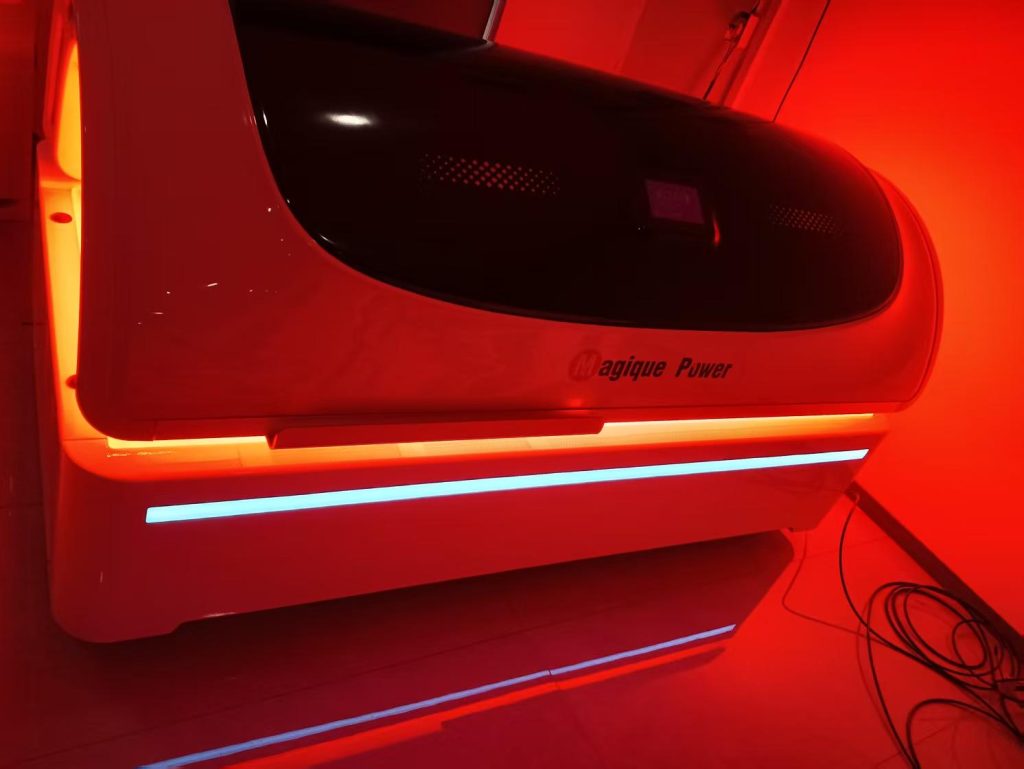
I want to peel that open with you. We’ll map the claims against real pain points and the devices that deliver them. Along the way I’ll name simple hardware terms—LED arrays, wavelength calibration, power converters—so we’re not speaking in fog. Ready to look deeper? Let’s move from the glow to what’s under the hood.
Why standard approaches to collagen bed therapy often fall short
Bold claim: many popular setups fail where it matters most. I’ve tested and read enough to say this with some certainty—standard red light rigs often prioritize surface spectacle over consistent delivery. That inconsistency is frustrating. Clinicians and users expect steady photon flux and precise wavelength, but what they get can be a sloppy mix of hotspots and weak zones. Look, it’s simpler than you think: if the light isn’t reaching the target dose evenly, results will vary wildly.

Two elements keep coming up. First, LED arrays that are poorly designed produce uneven irradiance. You can measure peak intensity with a radiometer and still miss gaps across the panel. Second, cheap power converters and inadequate heat dissipation cause spectral drift—wavelength calibration shifts under load, and photobiomodulation effectiveness drops. I’ve sat with technicians watching devices lose peak output within minutes of use—annoying and, frankly, avoidable.
So what breaks down in practice?
Manufacturers cut corners on thermal management. They skimp on driver electronics. Users assume “more LEDs = better,” but beam profile and uniformity matter more than raw count. And then there’s user behavior: session length, distance, and skin type all change outcomes. We can fix these gaps, but first we must admit they exist. — funny how that works, right?
New technology principles for better outcomes (and how to evaluate them)
Looking forward, I’m excited about systems that treat delivery as a precision task. Instead of lighting many diodes and hoping for the best, better designs use calibrated LED arrays, active thermal control, and pulse modulation to maintain consistent dose over a session. When I study a new model I check for three things: uniform irradiance maps, stable wavelength under load, and intelligent driver electronics that prevent flicker and drift. These are engineering principles, yes, but they translate directly into how your skin or muscle responds.
Take integrated sensors: smart beds that sample output and adjust current in real time can hold wavelength within narrow bands—this keeps photobiomodulation in its sweet spot. Power converters with current regulation and proper heat sinks mean less spectral drift. Edge-case detail: some manufacturers now use feedback loops (simple, elegant) so a unit self-corrects as it warms. That reduces session-to-session variance and makes outcomes repeatable. I’m not selling a dream here; I’m advocating for measurable control.
What’s next — practical testing and metrics?
When you compare options, look for objective readouts—irradiance maps, spectrum graphs, and thermal profiles. Try to see third-party testing, or at least insist on measured numbers rather than marketing words. I’ve learned to ask for dose maps and to test units at different distances. The results matter. If a system can’t show consistent output on paper, it won’t give consistent results in the clinic or at home.
Closing — three quick metrics I use to pick a reliable solution
I’ll leave you with three practical evaluation metrics that cut through the noise. First, uniformity score: ask for an irradiance map showing variation across the treatment area—lower variance means more even exposure. Second, spectral stability: a report that shows wavelength remains steady over a typical session (no drift). Third, thermal and driver specs: evidence that the unit uses regulated power converters, active cooling, or feedback control to prevent performance loss. These are measurable. They matter. They change outcomes.

I speak from hands-on testing and from conversations with clinicians; I care about results because I’ve witnessed both disappointment and delight. Choose with a clear checklist, not a pretty brochure. If you want a starting point, check device documentation and demand real numbers—then match them to your goals. And when you’re ready to explore proven equipment with solid engineering, consider Magique Power as one of the brands I often look at for transparent specs and honest testing.