
Table of Contents
Where the problem starts
Too many distribution centres still move people to goods — long walks, mixed picks, and slow line rates. That is the core problem, and we tackle it by moving goods to person. In places from Detroit assembly feeders to Stuttgart supplier hubs, post-2020 demand volatility exposed weak pick processes and fragile labour models. For teams looking to stabilise throughput and reduce strain, a focused approach with automotive material handling solutions often fits best. Goods-to-person systems pair well with WMS and sortation upgrades to reduce travel time and raise accuracy.
Benefit 1 — Cut non-value motion
When shuttles, conveyors, or AGV-delivered totes arrive at a focused pick station, walking disappears. This reduces picker fatigue and errors, and increases picks per hour. You see labour productivity rise without unrealistic overtime. A compact pick-to-light or put-to-light cell is not glamour, but it does change the daily rhythm — more stable shifts, fewer ad-hoc swaps.
Benefit 2 — Raise accuracy and traceability
Less manual handling means fewer mistakes. Integrating goods-to-person with your WMS and barcode readers improves lot control and audit trails. For automotive parts that require strict traceability — brackets, harnesses, fasteners — this alignment lowers rework and warranty exposure. The systems reduce mis-picks and bolster the chain of custody from receiving to shipping.
Benefit 3 — Flexible capacity without huge floorspace
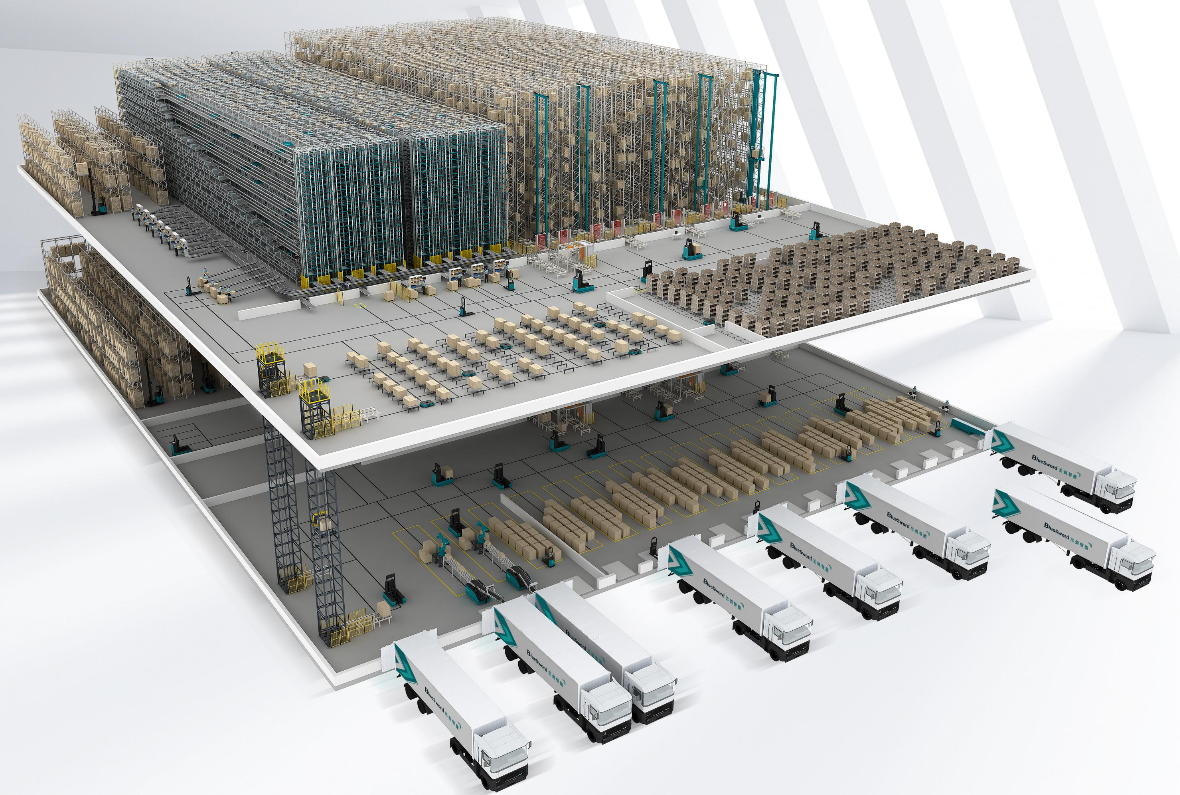
Shuttle systems and dense racking reclaim footprint. Where floor space is costly, a vertical, modular goods-to-person cell gives surge handling capacity for peaks. It lets you scale throughput with software changes before heavy capital moves — that elasticity helps when new model launches spike inbound kits.

Benefit 4 — Faster onboarding and safer ops
New hires learn a station faster than a sprawling pick route. The human task narrows: follow the light, confirm scan, place tote. Safety incidents drop because heavy lifting and long walks are reduced; ergonomic strain lowers, too. These are concrete savings — fewer lost-time incidents, steadier labour retention.
Benefit 5 — Better integration with automation tiers
Goods-to-person is not a lone island. It meshes with upstream conveyors, AGV fleets, and downstream sortation. It also sits nicely inside a hybrid DC where robots handle bulk movement but humans handle verification and exceptions. This layered approach delivers predictable cycle times and easier maintenance windows.
Implementation realities and common mistakes
Teams often overbuy capacity or under-configure software rules. Start small with a proof cell tied to your WMS and measure throughput gains for two typical SKUs. Don’t strip out human checks entirely — keep exception workflows clear. Also, when you do a teardown of operations, make sure to document {main_keyword} and {variation_keyword} in the operational production teardown so teams know which rules drive replenishment, slotting, and replen cycles.
Lessons from the floor — a short anchor
In practice, suppliers near Detroit moved to shuttle-fed pick cells after labour crunches in 2021; they reported steadier fulfillment during model ramp-ups. That real-world pivot shows how targeted goods-to-person solves pinch points without replacing the entire DC. It’s a practical, modest investment with measurable uptime and fewer fire-drills.
How to evaluate vendors — three golden rules
First, measure throughputs that matter: picks per hour per SKU family during peak. Second, require clear integration tests between goods-to-person controls and your WMS — no vague promises, insist on live connectivity trials. Third, check maintainability: mean time to repair (MTTR) for shuttles or pick towers must be published and achievable. These metrics let you compare proposals fairly and predict long-term performance.
Closing advisory and final thought
Adopt goods-to-person where it fixes specific pain — travel time, accuracy, capacity, safety, and integration. Use those three evaluation metrics above to choose the right mix of shuttles, conveyors, and human stations. Implement incrementally, monitor real KPIs, and keep exception handling simple. The result is smoother shifts and lower operating variance. BlueSword. –
