
Table of Contents
The problem: divergence between design intent and manufacturability
Engineers and procurement specialists routinely confront a common impasse: detailed CAD models that meet performance requirements often fail to translate into reliable prototypes within acceptable time and cost budgets. That mismatch creates schedule slippage, repeated iterations, and cost overruns—outcomes frequently traced to unrealistic tolerances, inappropriate material selection, or incomplete process planning. Early engagement with a precision parts manufacturer can expose these risks before they cascade into late-stage rework.
Root causes that require attention
Three recurring technical failures account for most prototype machining issues. First, over-constrained geometric tolerancing that disregards machine capability raises scrap rates. Second, material choices optimized for end-use—rather than for prototype realism—force unnecessary machining complexity. Third, absence of a clarity in functional criticality leads teams to apply uniform controls where selective controls would suffice. Addressing these root causes demands a disciplined framework that ties design intent to measurable manufacturing metrics.
Design principles mapped to manufacturing metrics
Define functional criticality. Classify features as functional, interface, or cosmetic, and assign tolerances only to functional features. Use ASME Y14.5 for explicit GD&T application and ISO 2768 for general tolerance baselines. Specify datum strategies that reflect assembly relationships rather than arbitrary coordinates. Quantify surface finish and form requirements using Ra and geometric form limits tied to the machining process.

Material and process suitability
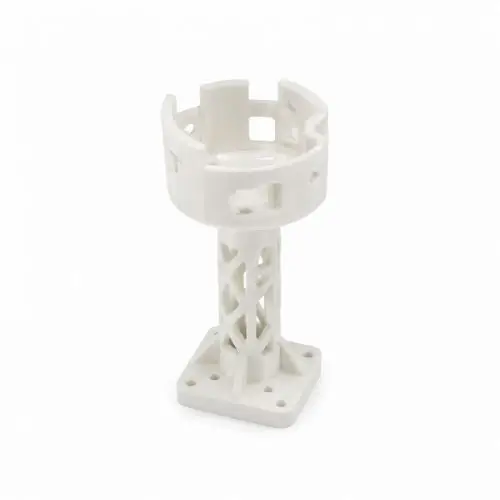
Select materials with prototype machining in mind. Metals such as 6061-T6 aluminum and 303 stainless steel balance machinability and representative mechanical properties. For high-temperature or high-wear prototypes, consider tool-steel grades but expect higher costs and longer lead times. Evaluate alternative processes—additive manufacturing for complex conformal geometries, vacuum casting for low-cost elastomeric copies, or soft tooling for short runs—against required fidelity, mechanical behavior, and delivery cadence.
Dimensioning, tolerances, and risk allocation
Adopt tolerance stacking analysis on assemblies to isolate the most sensitive features. Tighten tolerances only where analysis or test data demonstrated functional necessity. When a tight tolerance is unavoidable, specify the inspection method and acceptance criteria. Assign inspection responsibility and cost implications in procurement language so buyers and suppliers share the same risk model and expectations.
EEAT: experience, standards, and industry context
Guidance here reflects practical machining experience at bench and production levels, familiarity with GD&T best practices, and documented industry outcomes observed at major trade gatherings such as the International Manufacturing Technology Show (IMTS) in Chicago. Engineers should cross-reference standards and case studies when validating design choices. For teams evaluating supply options, direct collaboration with a specialist in prototype manufacturing clarifies achievable geometries, lead times, and inspection approaches, and reduces ambiguity in procurement specifications.
Common pitfalls and how to avoid them
Avoid three common mistakes. First, do not demand identical material properties for prototypes when functional equivalence suffices; specify representative mechanical targets instead. Second, do not assert blanket surface finish or tolerance requirements across all features; apply controls based on functional need. Third, do not exclude suppliers from early design reviews; their process knowledge often reveals simpler, lower-risk solutions. Mitigate these pitfalls by documenting assumptions, running tolerance simulations, and scheduling a manufacturability review prior to final release.
Evaluating alternatives: trade-offs and decision criteria
Compare processes by five criteria: geometric fidelity, mechanical representativeness, turnaround, cost per part, and scalability to small runs. Additive manufacturing offers rapid iteration and complex geometry but may lack required surface finish or isotropic properties. CNC machining yields tight form and finish but can be costly for thin-walled or highly undercut parts. Low-pressure casting or soft tooling can bridge the gap for small production quantities where surface finish and elastomeric behavior matter. Document decision traceability so choices align with test plans and product validation needs.
Supplier assessment and procurement language
Request capability statements that include machine tools, spindle speeds, tool libraries, and first-article inspection protocols. Insist on sample reports showing how similar tolerance classes were achieved and measured. Define acceptance criteria in purchase orders: measurement methods, lot sampling, and nonconformance disposition. Clarify lead-time expectations and change-order procedures to prevent schedule surprises.
Conclusion: pragmatic integration of design and manufacturing
Resolve prototype machining challenges by aligning functional requirements with measurable manufacturing parameters, by selecting processes that match the part’s critical attributes, and by embedding supplier expertise into the design lifecycle. Clear standards, targeted tolerancing, and early supplier engagement produce prototypes that validate design intent without unnecessary expense or delay, and these outcomes are what experienced teams expect when they work with Hanstar.
